


Beyond Launch: The Scaling Series(2 of 5)
Every business wants to scale. Automation and AI have become the go-to answers. But too often, the journey from manual operations to “AI-first” becomes bloated with tools that sound smart but don’t solve real problems.
We see that founders or businesses are constantly pitched with promises: “automate this,” “AI-enable that,” “deploy agents to run your business.” The challenge? Not every process needs an agent. Not every decision benefits from abstraction. And not every product should scale through AI before the problem is clearly understood.
At Teckollab, we work closely with purpose-driven businesses to define the right level of automation – progressively, mindfully, and with clarity.
The Cost of Going Too Far, Too Fast
Here’s what happens when you bloat your operations with misaligned AI:
- Maintenance complexity: More code, more integrations, more updates – means more time maintaining features no one asked for.
- User friction: Fancy chatbots or workflows might confuse users who just wanted a simple form or direct human contact.
- Team misalignment: Operations and support teams become dependent on automations they don’t understand or can’t tweak.
- Feature overload: You end up with layers of tools, scripts, and AI wrappers without clear outcomes.
Less is often more. Scaling should mean scaling impact, not systems.
When to Introduce AI, ML, and Agentic Automation
Knowing what to automate and how far to go is the real game. Here’s a high-level guide we use with partners:
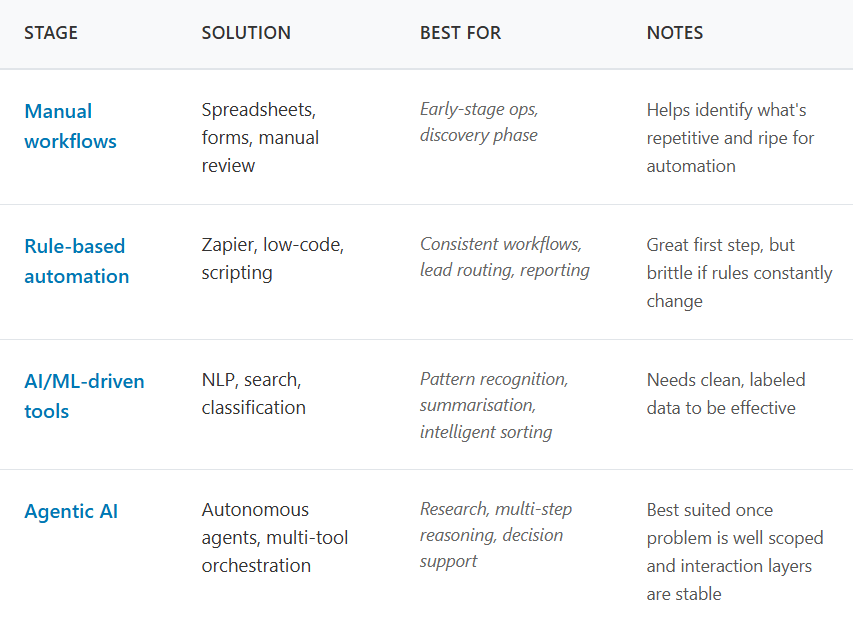
Use Cases Across Domains Teckollab Operates In
Below are three use cases reflecting progressive AI integration across industries/domains Teckollab operates in – impact, collaboration, marketplaces, culture and research:
1. Research-Centric Content Operations
Stage: Assistive → Agentic AI AI Types: NLP, LLMs, Semantic Search
Use Case: Research organisations often struggle to communicate findings effectively. Manually distilling dense documents into accessible formats is time-consuming.
AI can help by:
- Ingesting research from internal docs, websites, spreadsheets
- Performing semantic search across datasets
- Creating synopses, blog-ready articles, or contextual reports
Example: A research platform uses semantic search and vector embeddings to match institutional theses and scholar projects, enabling contextual access to relevant research without relying on keywords.
2. Connecting Purpose-Driven Service Providers & Receivers
Stage: Automation → ML Matching AI Types: Classification, Recommendation Models
Use Case: Platforms supporting independent professionals, mentors, or service-driven marketplaces often struggle to efficiently match providers and receivers.
AI can help by:
- Profiling users and learning from interactions
- Matching based on interest, location, and context
- Automating discovery and suggestions
Example: An adaptive matchmaking agent continuously learns from successful investor–founder connections and feedback loops to refine future recommendations.
3. Intelligent Matching in Marketplaces or Collaboration Platforms
Stage: ML-first → Agentic AI AI Types: ML Models, Feedback Loops, Embedded Agents
Use Case: Marketplaces thrive on matching supply and demand efficiently. But scaling operations manually leads to bottlenecks.
AI can help by:
- Matching offers with demand using continuous feedback loops
- Dynamically reprioritising based on engagement
- Using agents to onboard, follow-up, or adjust listings autonomously
Example: A digital collaboration hub matches NGOs with social innovation projects using AI to surface relevant opportunities and deploys agents to handle onboarding steps.
Agentic AI in Practice
Agentic systems are now more than just concept. They can plan, search, synthesize and act with minimal prompts. But success hinges on thoughtful architecture.
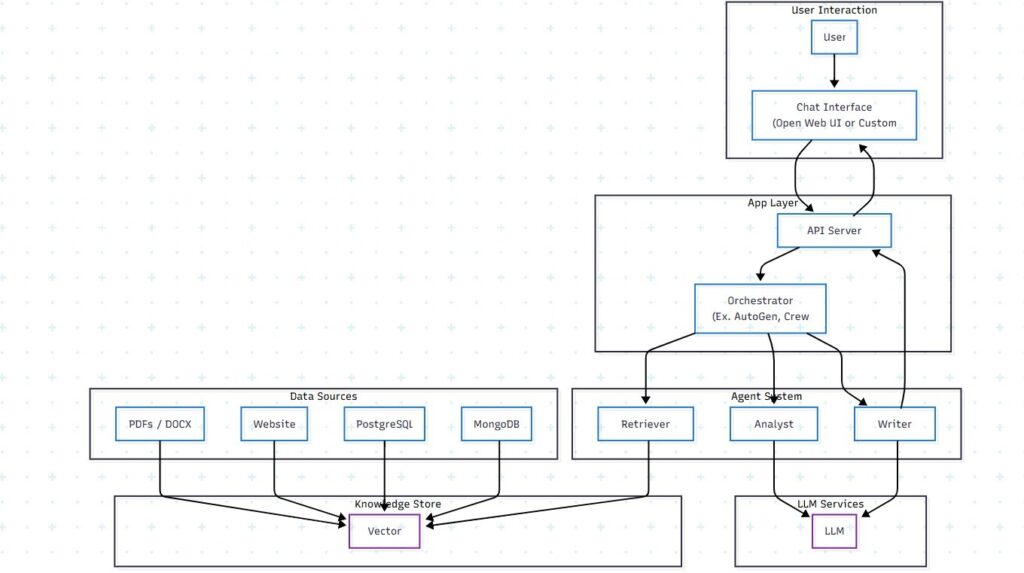
This allows the users – founders, researchers and project leads to ask questions, receive contextual summaries, and even trigger actions across platforms, without needing to learn the underlying tools.
Final Thoughts
AI should not be a layer you throw in to impress users or investors. It should be aligned with the reality of your operations, your team’s capability to maintain it, and the clarity of the problem being solved.
As we build alongside purpose-driven partners, our goal at Teckollab remains simple: scale with intention, automate with context, and always start with impact.
Let’s explore what your product needs and find the smartest way to unlock it—without burning time, money, or momentum.
📩 Get in touch for a discovery session.
Other episodes in Beyond Launch: The Scaling Series:
Episode 1: Data Sourcing: The Hidden Roadblock to Scaling SaaS Products
Episode 3: Compliance: From Follower to Framework Builder
Episode 4: Ecosystem integration from connection to revenue engine
Episode 5(Coming soon): Human Experience: The Difference Between Growing and Stalling
Leave a Reply